Headnote
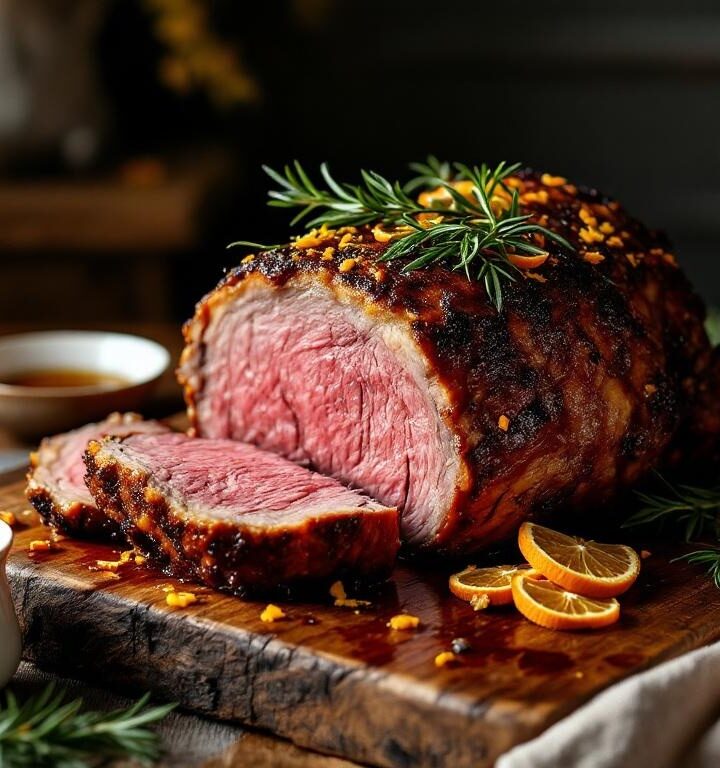
Vadouvan is a French colonisation of South Asian spice — a curry masala slow-cooked with shallots, garlic, and dried fenugreek until it becomes something cohesive enough to be sold in Breton épiceries. It occupies an odd, useful position: French enough for a Sunday gigot, South Asian enough to feel familiar if you grew up eating lamb with cumin and coriander. This recipe is a rubbed, slow-roasted leg of lamb that borrows the French logic of fat-as-carrier (butter rubbed under and over the skin, carrying the aromatics into the meat) and applies vadouvan where a French cook might use herbes de Provence. Orange zest and rosemary both belong in the southern French register; the pink peppercorn is a bit of showing off, but it earns its place. Four hours in the oven at moderate heat. The result is a crust that shatters and a centre that pulls.
—
At a glance
| | |
|—|—|
| Total time | 4 hours (30 min active) |
| Servings | 8 |
| Difficulty | Medium |
| Key technique | Butter-paste rub; low-and-slow roasting |
—
Ingredients
Vadouvan butter rub
- 225 g (2 sticks / 8 oz) unsalted butter, softened to room temperature
- 3 tablespoons vadouvan (see Ingredient notes)
- 2 tablespoons coarsely grated orange zest (from roughly 2 large oranges)
- 2 tablespoons fresh rosemary, finely chopped
- 2 tablespoons kosher salt
- 1 tablespoon pink peppercorns, lightly crushed
- 1 teaspoon freshly ground black pepper
Lamb
- 1 semi-boneless leg of lamb, shank bone in, approximately 3.8–4.1 kg (8½–9 lb)
- 240 ml (1 cup) water
—
Ingredient notes
Vadouvan. Available in well-stocked French épiceries, some Monoprix branches, and online from La Boîte NYC or similar spice specialists. It smells of dried shallot and fenugreek before anything else, with curry leaf and turmeric underneath. If you cannot find it, use a good Madras-style curry powder at the same quantity, but add an extra half-teaspoon of dried fenugreek leaves (kasuri methi) to get closer to the profile. The result will differ — vadouvan is sweeter and more allium-forward — but it will not be wrong.
Butter. Use halal-certified unsalted butter. Most French AOC butters carry no animal rennet concern, but check your supplier. The fat is essential to the technique: it binds the dry spices and bastes the meat throughout the roast. Do not swap for oil; the milk solids in butter brown and contribute flavour that olive oil cannot replicate at this temperature.
Pink peppercorns. These are Schinus berries, not true peppercorns. They are fruity, mildly resinous, with less heat than black pepper. Buy them whole and crush them yourself in a mortar; pre-ground pink pepper loses the floral note within weeks.
Semi-boneless leg. The femur is removed but the shank bone remains. This makes carving straightforward while the bone still conducts heat toward the centre. A fully bone-in leg will need an extra 20–30 minutes; a fully boneless leg, tied, will need 20 minutes less.
—
Method
- Bring the lamb to temperature. Remove the lamb from the refrigerator 1 hour before roasting. Cold meat going into a hot oven extends cooking time unpredictably and gives you a grey band under the crust.
- Make the butter paste. In a bowl, work together the softened butter, vadouvan, orange zest, rosemary, kosher salt, crushed pink peppercorns, and black pepper with a fork until fully combined. The mixture should be spreadable but hold its shape. This paste is the delivery mechanism for every flavour in the dish.
- Preheat the oven to 160 °C (325 °F), conventional heat. Not fan-forced; fan-forced will dry the surface before the interior has cooked.
- Rub the lamb. Set the leg on a rack inside a large roasting tin. Using your hands, press half the butter paste under any loose flaps of fat or pockets where the bone was removed. Rub the remaining paste over the entire exterior surface, including underneath. You want an even, generous coating.
- Add water to the tin. Pour 240 ml (1 cup) of cold water into the bottom of the roasting tin, not over the meat. This creates enough steam in the early phase to prevent the drippings from burning and gives you a base for the pan juices later.
- Roast. Place the tin in the oven. Roast for 3 hours without opening the door. The low temperature and fat coating do the work; resist the impulse to baste. After 3 hours, check the internal temperature at the thickest point: you are aiming for 60–63 °C (140–145 °F) for medium-pink.
- Finish the crust. Raise the oven to 220 °C (425 °F) and roast for a further 20–25 minutes until the crust is deeply bronzed and the butter paste has caramelised onto the surface. Watch it; at this stage it goes from good to scorched in ten minutes.
- Rest. Transfer the lamb to a cutting board and tent loosely with foil. Rest for at least 20 minutes. The internal temperature will rise another 3–5 degrees during this time, and the juices will redistribute. Carving immediately wastes both.
- Make a quick pan sauce. Set the roasting tin over medium heat on the hob. Scrape up the darkened drippings and vadouvan sediment. If the tin is dry, add a splash of lamb stock or water. Taste and adjust salt. Strain through a fine sieve into a warm jug. This is not a formal sauce; it is concentrated roasting juices, and it is better for being honest about that.
- Carve and serve. Slice against the grain, starting from the thick end. Serve with the pan juices alongside.
—
Variations
Shoulder instead of leg. A bone-in shoulder of the same weight is cheaper and more forgiving. Extend the low-temperature phase to 3 hours 30 minutes; the higher collagen content means it benefits from longer cooking. The crust will be less refined but the flavour is deeper.
Lamb shanks. Use four shanks (roughly 450 g / 1 lb each), halve the butter paste quantity, and roast covered in a Dutch oven at 160 °C (325 °F) for 2 hours 30 minutes, then uncovered for 30 minutes to set the crust. A different format of the same flavour logic.
No butter (dairy-free). Replace the butter with 120 ml (½ cup) of coconut oil, refined not virgin, plus 60 ml (¼ cup) of a neutral oil. The coconut oil solidifies at room temperature like butter and carries the spices adequately. The flavour will lack the milk-solid nuttiness but the technique holds.
More South Asian profile. Add 1 teaspoon of ground cumin, ½ teaspoon of ground coriander, and ¼ teaspoon of Kashmiri chilli powder to the butter paste. This tilts the dish toward Lahori roast lamb territory, still in a French cooking format.
—
Storage and reheating
Refrigerate leftover carved lamb in an airtight container with any reserved pan juices poured over the top. It keeps for four days. The fat will solidify; that is fine.
To reheat: arrange slices in a single layer in a baking dish, add 2–3 tablespoons of water or stock, cover tightly with foil, and heat at 150 °C (300 °F) for 15–20 minutes. The goal is warming through without further cooking. Do not microwave a full portion; the exterior dries before the centre heats.
Leftover lamb makes excellent sandwiches with harissa and sliced tomato, or a quick pilaf base.
—
FAQ
Can I use a boneless leg of lamb?
Yes. A boneless leg tied into a roll will cook in roughly 2 hours 30 minutes to 2 hours 45 minutes at 160 °C (325 °F) before the high-heat finish. The bone conducts heat inward in the semi-boneless cut, so without it the cooking time is shorter. Use a probe thermometer and target 60 °C (140 °F) at the centre.
My vadouvan paste seems very salty. Should I reduce the salt?
Kosher salt (specifically Diamond Crystal) is about half as salty by volume as table salt or Morton's. The 2-tablespoon quantity is calibrated for Diamond Crystal over a 4 kg joint. If using fine table salt, reduce to 1 tablespoon. If using Morton's kosher salt, use 1 tablespoon plus 1 teaspoon.
How do I know when the crust phase is done without burning it?
Colour is your guide. You want the surface to look deeply bronzed and dry, not blackened. The butter paste goes through three stages at high heat: melted, bubbling, and set. Once it stops bubbling and the surface looks matte and dark, it is done. Check at 20 minutes; do not walk away.
Can I prepare this the day before?
The butter paste can be made and applied to the lamb up to 24 hours ahead. Cover the rubbed joint with cling film and refrigerate. Remove it one hour before roasting. The salt in the rub will draw surface moisture from the meat overnight and reabsorb, which slightly deepens the crust.
What should I serve with this?
The pan juices are French in character but the spice is South Asian. Both work with a simple white bean purée or lentils cooked with garlic and olive oil. Plain basmati rice is not wrong. Avoid anything acidic (tomato-heavy salads) served directly against the lamb; the orange zest in the crust is doing that work already.
Is vadouvan the same as curry powder?
No, but they share some ingredients. Vadouvan is a French adaptation of a South Indian masala that incorporates shallots and garlic into the spice blend itself before drying. It is sweeter, less sharp, and more aromatic than a standard curry powder. The substitution works technically but the flavour is flatter.
