Headnote
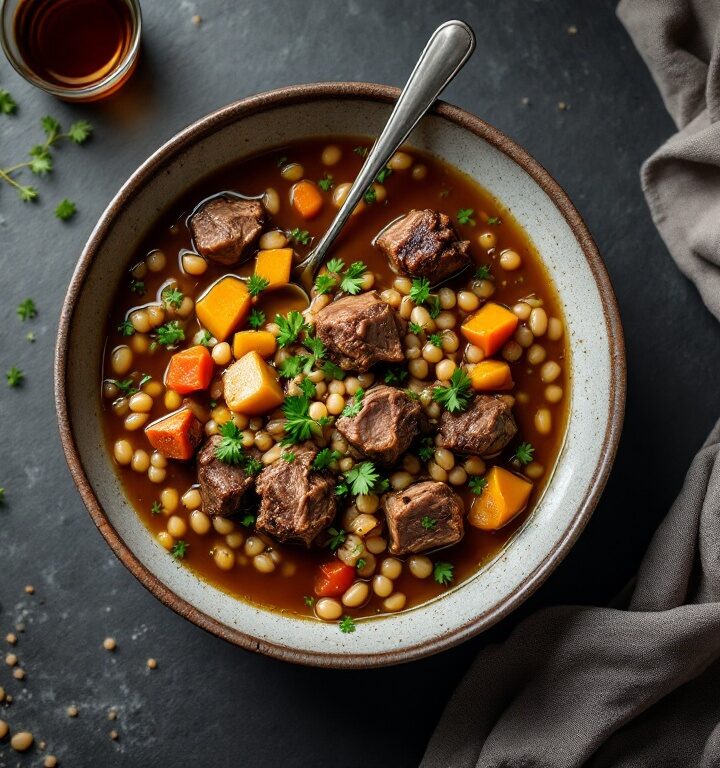
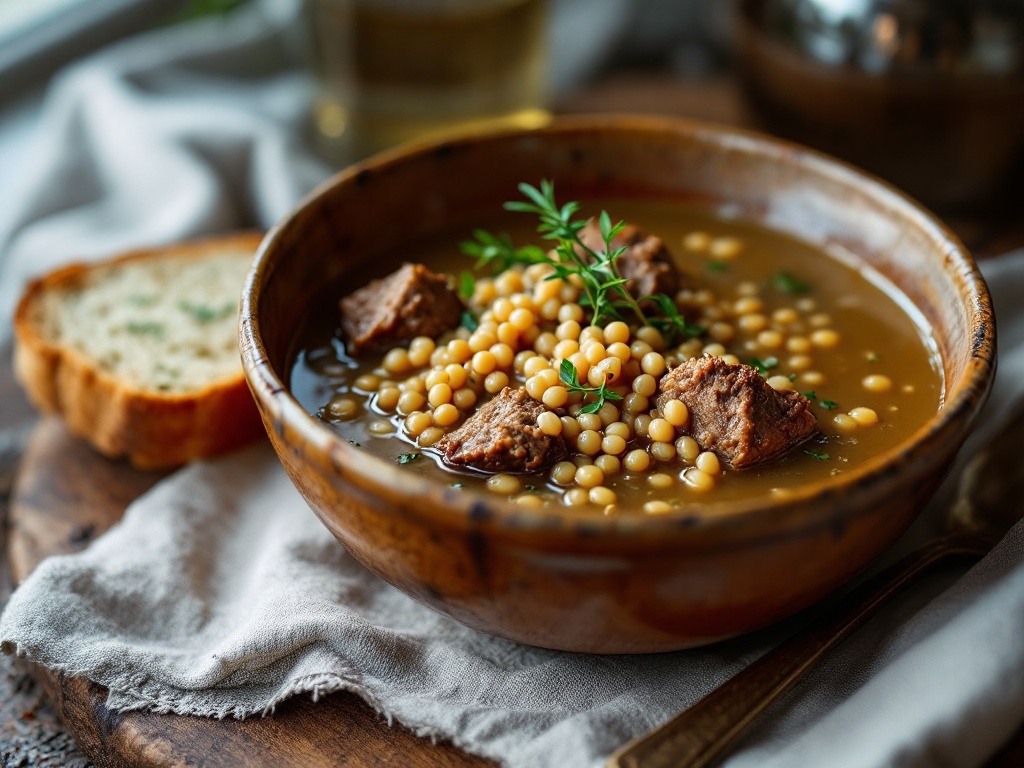
Scoths Broth is one of those dishes that has no glamour whatsoever on paper — a bone, some barley, a few root vegetables — and then completely surprises you in the bowl. The technique that makes it work is French in spirit: hard searing of the meat until the fond on the pan bottom is genuinely dark, not pale gold. That Maillard crust dissolves into the broth over a long simmer and becomes the flavour. The barley is not a garnish; it thickens the liquid to something almost silky by the time the shanks are tender. This is not a refined dish. It is an honest one. Cold evening food, the kind you eat with bread and no starter and no dessert either.
—
At a Glance
| | |
|—|—|
| Total time | 2 hrs 30 min (20 min active) |
| Servings | 4 |
| Difficulty | Easy |
| Key technique | Deep searing for fond, low simmer for collagen |
—
Ingredients
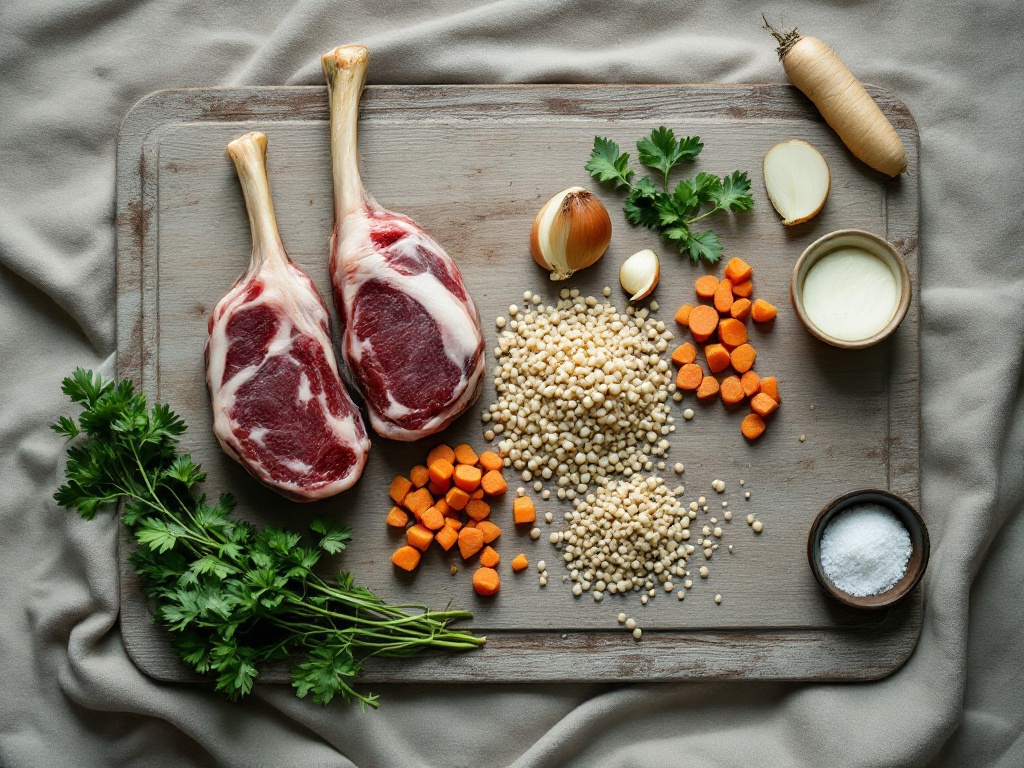
For the broth
- 450 g (1 lb) lamb shanks — about 2 medium shanks
- Fine salt and freshly ground black pepper
- 2 tablespoons vegetable oil
- 2 bay leaves
- 3 medium garlic cloves, peeled and lightly crushed
- 1 medium onion (about 200 g / 7 oz), finely chopped
- 1.9 litres (8 cups) low-sodium chicken stock, or lamb stock if you have it
- 2 medium carrots (about 220 g / 8 oz), finely diced
- 1 medium parsnip (about 130 g / 4.5 oz), finely diced
- 1 medium russet potato (about 220 g / 8 oz), finely diced
- 65 g (⅓ cup) pearl barley
- 2 tablespoons flat-leaf parsley, finely chopped
—
Ingredient Notes
Lamb shanks. You want bone-in shanks, not boneless leg. The bone contributes gelatin; that gelatin is what gives the finished broth its body. Pakistani butchers in most French cities (and halal butchers in the UK) sell shanks cut to order. Ask for them to be left whole.
Pearl barley. Not pot barley. Pearl barley has had the bran polished off, so it cooks in roughly 40 minutes within the broth and releases enough starch to give the soup a pleasant, slightly thickened texture. Pot barley is nutritionally superior but needs either pre-soaking or a longer cook.
Stock. Chicken stock works here and is easily sourced halal. Lamb stock is better. If you make stock from lamb neck bones or have reserved carcass bones from a previous roast, use it. The broth will taste more of itself.
Parsnip. Often absent from versions of this soup made outside Britain. Keep it. It adds a faint sweetness that balances the barley's earthiness. If you cannot find parsnip, a small turnip will do.
—
Method
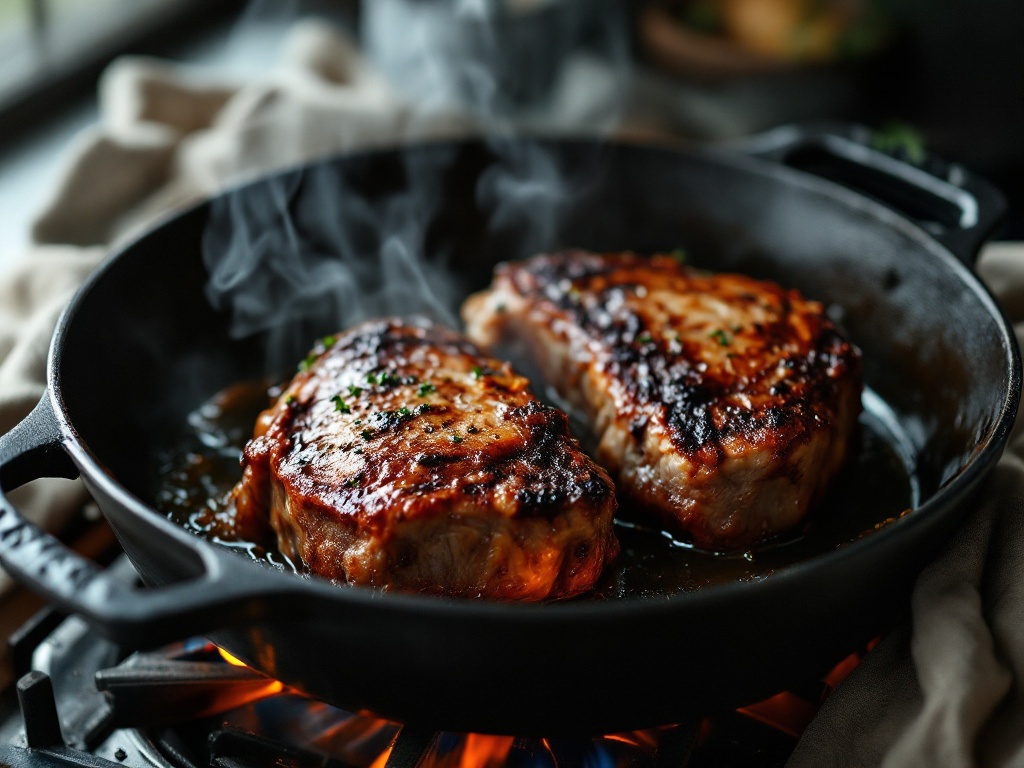
- Season the shanks generously with salt and pepper on all sides. Do not be polite about this; meat of this size needs more seasoning than you think.
- Heat the oil in a large heavy-bottomed pot or Dutch oven (at least 4-litre capacity) over high heat until it just begins to shimmer and smoke slightly. Add the shanks. Do not move them for at least 3 minutes. You are building fond — the browned layer that adheres to the pan — and disturbing the meat before the crust forms properly tears it loose and leaves it in the oil, not on the meat.
- Turn and sear all surfaces. Each side should be deep mahogany, not amber. This takes 8 to 10 minutes total. Remove the shanks and set aside.
- Reduce heat to medium. Add the onion and garlic to the same pot without draining the fat. The fond fragments will lift as the onion releases moisture. Cook, stirring occasionally, until the onion is fully soft and starting to colour at the edges — about 6 minutes.
- Add the bay leaves, then return the shanks to the pot. Pour in the stock. The liquid should cover the shanks by at least 2 cm (¾ inch). If it does not, add water.
- Bring to a bare simmer — you want occasional bubbles breaking the surface, not a rolling boil. Boiling toughens the meat and clouds the broth. Adjust the heat, partially cover, and cook for 1 hour.
- Add the barley, carrots, parsnip, and potato. Stir once to combine. Continue simmering, partially covered, for another 45 to 55 minutes, until the barley is fully tender and the vegetables have softened into the broth. The potato will largely dissolve; this is the intention. It thickens the base alongside the barley.
- Remove the shanks. When cool enough to handle, pull the meat from the bone in rough chunks and return it to the pot. Discard the bone, the bay leaves, and the garlic cloves if you find them.
- Taste and adjust seasoning. Broth always needs more salt than you expect after a long simmer. Add parsley, stir once, and serve immediately.
—
Variations
Cheaper cut. Swap the shanks for 450 g of bone-in lamb neck pieces. Neck has more connective tissue and will produce an even silkier broth. The cook time stays roughly the same; check for tenderness at the 90-minute mark.
Turnip and swede version. Replace the parsnip with equal-weight diced swede (rutabaga) and omit the potato. More traditional to the Scottish Highlands version, and slightly less starchy.
Lamb-free, still meaty. Use 450 g of bone-in beef shin instead of lamb. The flavour profile shifts — less sweet, more mineral — but the technique is identical. Extend the initial simmer to 1 hr 30 min before adding the vegetables.
Spiced version. Add half a teaspoon of ground cumin and a small cinnamon stick with the bay leaves in step 5. This version slides toward a Maghrebi register without becoming a different dish. The barley and root vegetables hold the spice without being overwhelmed.
—
Storage and Reheating
Allow the broth to cool to room temperature, then transfer to an airtight container. It keeps in the refrigerator for up to 4 days. The barley will continue absorbing liquid as it sits; add a splash of stock or water when reheating to restore the original consistency.
For freezing, portion into 500 ml containers and freeze for up to 3 months. Defrost overnight in the refrigerator. Reheat in a saucepan over medium-low heat, stirring occasionally. Do not boil; the vegetables will disintegrate completely if boiled a second time.
—
FAQ
Can I use boneless lamb instead of shanks?
You can, but the broth will be thinner. Gelatin comes from collagen in bones and connective tissue; without the bone, you will need to compensate by using a rich stock rather than water, or by adding a small amount of unflavoured halal gelatin powder at the end.
My broth looks cloudy. Did I do something wrong?
Not necessarily. Cloudiness usually means the liquid boiled rather than simmered, which emulsifies the fat and agitates the proteins. It does not affect flavour. If clarity matters to you, strain the broth through a fine-mesh sieve before returning the meat and vegetables — a time-consuming step that is strictly optional.
Do I need to soak the pearl barley before cooking?
No. Pearl barley cooks directly in the broth within 45 to 55 minutes and releases starch gradually, which is what you want. Soaking it would speed up the cook but reduce that thickening effect.
Can I make this in a pressure cooker?
Yes. Sear the shanks in the pressure cooker insert using the sauté function, then add the onion, garlic, bay leaves, and stock. Pressure cook on high for 35 minutes. Release pressure, add the barley and vegetables, then pressure cook for a further 12 minutes on high. Finish with parsley and adjust seasoning.
How do I know when the lamb is actually done?
The meat should pull away from the bone with no resistance. If you have to tug, it needs more time. Lamb shank collagen converts to gelatin at around 80°C (175°F) sustained over time; the goal is tenderness through time and temperature, not simply reaching an internal temperature and stopping.
The broth tastes flat even though I seasoned well. What happened?
This is almost always a stock problem. Store-bought low-sodium stock is often thin. A small fix: add a tablespoon of tomato paste with the onions in step 4 and let it cook for two minutes before adding the stock. This adds depth and a slight acidity that activates the other flavours without changing the character of the dish.