Headnote
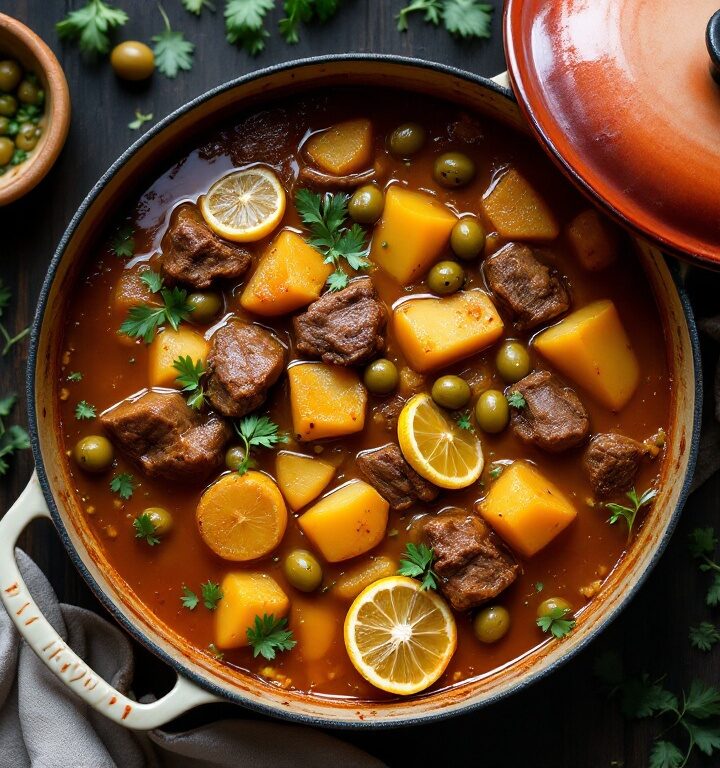
Morocco and France share more culinary grammar than either country's textbooks admit. Both traditions understand the slow braise: low heat, aromatics built in fat, acid introduced late to lift the whole thing. This tagine follows that logic exactly. Saffron and turmeric lay down colour and depth; preserved lemon and olives arrive near the end because their job is contrast, not blending. The beef goes in lean and cubed, and the collagen does the rest over an hour of unhurried simmering. No clay tagine required — a heavy-bottomed casserole works as well, sometimes better for even heat distribution on a European hob. This is Moroccan cooking, clearly. What halal French cooking contributes is the discipline: mise en place, layered seasoning, and the understanding that the fond at the bottom of the pan is not a problem to scrub away.
—
At a glance
| | |
|—|—|
| Total time | 60 minutes |
| Servings | 5 |
| Difficulty | Easy |
| Key technique | Building a layered braising liquid; acid added late |
—
Ingredients
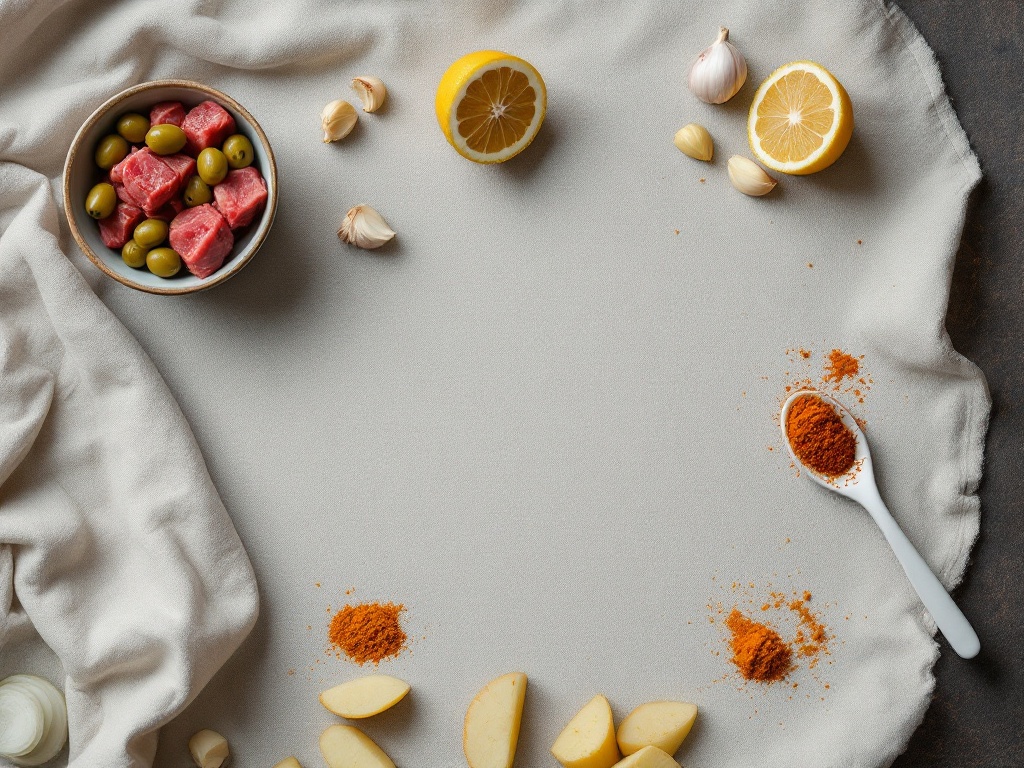
Aromatics and spice base
- 1 large onion, thinly sliced
- 3 garlic cloves, grated or crushed
- 80 ml (⅓ cup) extra-virgin olive oil
- 1 tsp ground ginger
- 1 tsp ground turmeric
- ½ tsp ground black pepper
- 2 tsp fine salt, or to taste
- 1 pinch saffron threads (optional but recommended)
- 1 green cayenne chilli, left whole (optional)
Main
- 500 g (1.1 lb) lean halal beef, diced into 4 cm (1½ in) cubes
- 700 g (1.5 lb) waxy potatoes, peeled and cut into wedges
- 700 ml (3 cups) water
Finishing
- 1 large handful green or red olives, unstoned or pitted
- ½ preserved lemon, quartered lengthways
- 1 handful flat-leaf parsley or coriander, roughly chopped
—
Ingredient notes
Preserved lemon. This is the backbone of the dish's final flavour. It is cured lemon rind — the pulp is scraped away and discarded; only the rind goes in. You find it at any North African grocery and increasingly at mainstream French supermarkets. If you cannot find it, the substitution is a 5 cm strip of fresh lemon zest plus a small squeeze of juice, added in the last five minutes. The result is sharper and less complex, but it works.
Saffron. Bloom it in two tablespoons of warm water for ten minutes before adding. This is not optional technique — dry saffron threads added to a braising pot release maybe a third of their colour and flavour. The blooming extracts both.
Beef cut. Lean beef dices well but can dry out in shorter braises. Chuck or braising steak from a halal butcher gives better results here: it has enough intramuscular fat to stay moist over an hour. If using topside or silverside, reduce water by 100 ml and check at 45 minutes.
Olives. Cracked green Moroccan olives are traditional and correct. Kalamata work too and are easier to find. Rinse them regardless of the brine they come in — both salt and acid levels vary wildly between brands.
—
Method
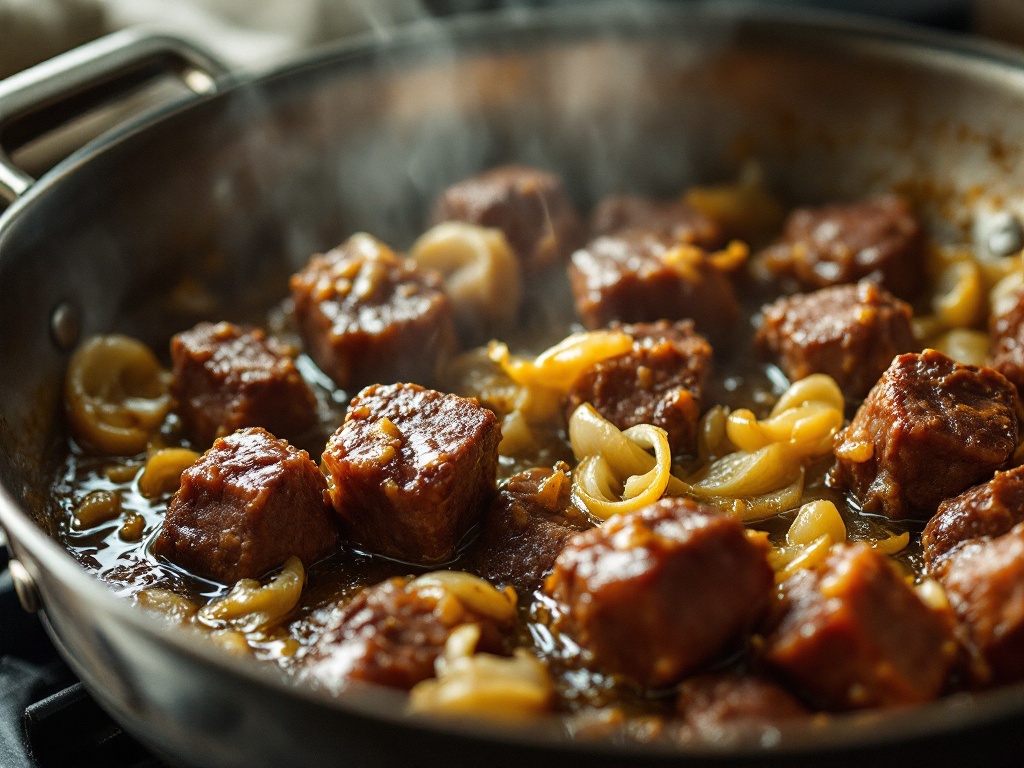
- Build the base. In a large heavy casserole or tagine over medium heat, warm the olive oil. Add the sliced onion and cook, stirring occasionally, until softened and beginning to colour — about 8 minutes. Do not rush this. An underdone onion base makes a watery, flat-tasting braise.
- Add the garlic and dry spices. Add the grated garlic, ginger, turmeric, black pepper, and salt. Stir continuously for 90 seconds. The spices are toasting in the oil, not burning; if the pan smells harsh rather than fragrant, the heat is too high.
- Sear the beef. Add the beef cubes and turn them in the spiced onion mixture until all surfaces are coated and starting to colour, about 4 minutes. You are not looking for a hard restaurant sear here — the goal is that each cube picks up colour and the fond begins to develop on the pan bottom.
- Add liquid and saffron. Pour in the water and add the bloomed saffron with its soaking liquid. If using a whole chilli, add it now. Bring to a gentle simmer, cover, and cook for 20 minutes.
- Add the potatoes. Nestle the potato wedges into the braise. They should be mostly submerged; add a splash more water if not. Replace the lid and continue cooking over low heat for 20 to 25 minutes, until the potatoes are tender through and the beef gives easily when pressed with the back of a spoon.
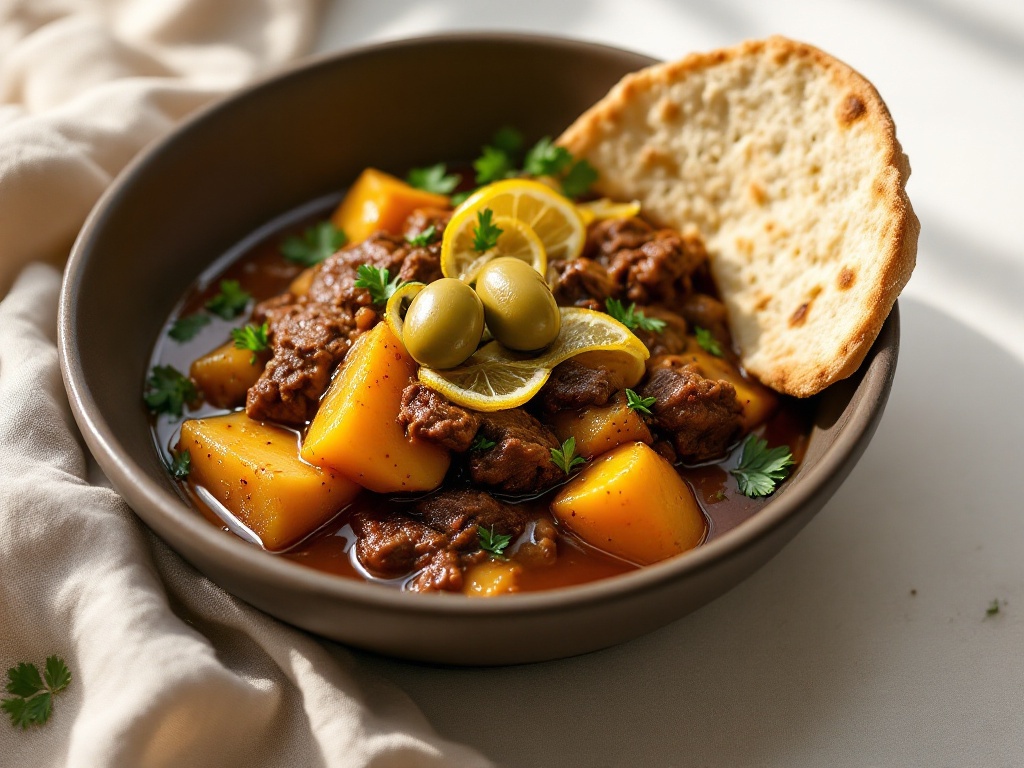
- Finish with olives and preserved lemon. Add the rinsed olives and the quartered preserved lemon rind. Cook uncovered for a final 5 minutes. This is when the broth concentrates slightly and the sharp, saline notes of the lemon and olives marry with the saffron. Do not add them earlier — prolonged cooking turns preserved lemon bitter and dulls the olives.
- Adjust and serve. Taste the broth. It will likely need nothing, but check for salt. The preserved lemon contributes significant salinity, so season only after it has been in the pot. Scatter the parsley or coriander over the top and bring the pot to the table.
—
Variations
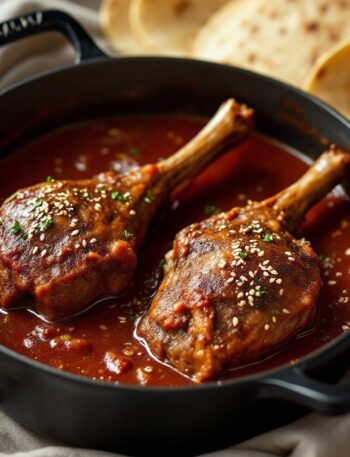
Lamb shoulder instead of beef. Cut bone-in lamb shoulder into large pieces. Increase the cooking time at step 4 to 35 minutes before adding potatoes, and at step 5 to 30 minutes. The broth will be richer and the fat more visible; skim the surface before finishing.
Without potatoes, over couscous. Skip the potatoes entirely. Reduce the water to 400 ml (the potato starch would have thickened the broth; without it, you want less liquid). Serve over steamed couscous.
Vegetarian version. Replace the beef with 400 g (14 oz) canned chickpeas, drained, and 2 medium courgettes cut into thick rounds. Add chickpeas at step 4, courgettes at step 5. Reduce total cooking time to 30 minutes. The broth is lighter; consider adding a teaspoon of ras el hanout to compensate.
Cheaper cut, longer time. Beef shin or oxtail diced across the bone gives a gelatinous, deeply flavoured broth. The total braising time doubles to around 90 minutes at step 4 before the potatoes go in, but the result is markedly better.
—
Storage and reheating
Allow the pot to cool completely, then transfer to a sealed container. Refrigerate for up to 3 days. The flavour deepens overnight — this is genuinely better the second day.
To reheat: place in a saucepan over low heat with a splash of water. Stir gently, ensuring the potatoes do not break up. Do not microwave aggressively; the potato texture suffers badly at high power.
Freezes well for up to 2 months. Freeze without the parsley garnish; add fresh herb when reheating.
—
FAQ
Can I make this in a slow cooker?
Yes. Complete steps 1 through 3 in a frying pan, then transfer everything to the slow cooker with the water and saffron. Cook on low for 6 to 7 hours. Add the potatoes in the last 2 hours, the olives and preserved lemon in the last 20 minutes. Remove the lid for the final 10 minutes to concentrate the broth slightly.
Do I need an actual tagine pot?
No. A tagine's conical lid is designed to circulate steam in an environment without precise temperature control. On a modern hob with a heavy casserole and a well-fitting lid, you achieve the same result. A tagine pot also cracks on direct high heat, which creates more problems than it solves.
My broth tastes flat. What went wrong?
Almost certainly the spices were not toasted long enough at step 2, or the onion was not cooked down sufficiently at step 1. A flat braise also happens when the saffron was added dry rather than bloomed. If you are rescuing the dish mid-cook, stir in a small pinch of saffron bloomed in warm water, cover, and give it another 10 minutes.
The preserved lemon is making the dish too salty. How do I fix it?
Rinse the preserved lemon rind under cold water before adding it, and hold back all other salt until the very end of cooking, after the lemon has had its five minutes. If the dish is already over-salted, add a peeled, quartered raw potato to the pot for the last 10 minutes — the starch absorbs excess salt with reasonable efficiency.
Can I use chicken instead of beef?
Yes. Bone-in chicken thighs work well. Reduce the initial simmer at step 4 to 15 minutes, add potatoes and cook a further 20 minutes. Total active cooking time drops to around 50 minutes. The broth will be lighter; this is not a flaw.
Is this dish actually halal?
The recipe uses only halal-certified beef (confirmed at purchase from a halal butcher), no alcohol, no pork products, and no shellfish. Every ingredient is permissible under standard Hanafi and Shafi'i guidelines. Saffron, olives, and preserved lemon are all halal without qualification.
What do I serve alongside this?
Moroccan bread (khobz) for the broth, which is worth having. A simple cucumber and tomato salad dressed with cumin and lemon. If you skip the potatoes inside the tagine (see Variations), couscous steamed with a little butter and salt is the right call.